
Typical experience of using Glutamate (MSG) in clinical nutrition support


Besides its effects to make food tastier, scientific studies proved that glutamate (MSG) is effective in supporting clinical nutrition, thereby brings numerous health benefits to human.

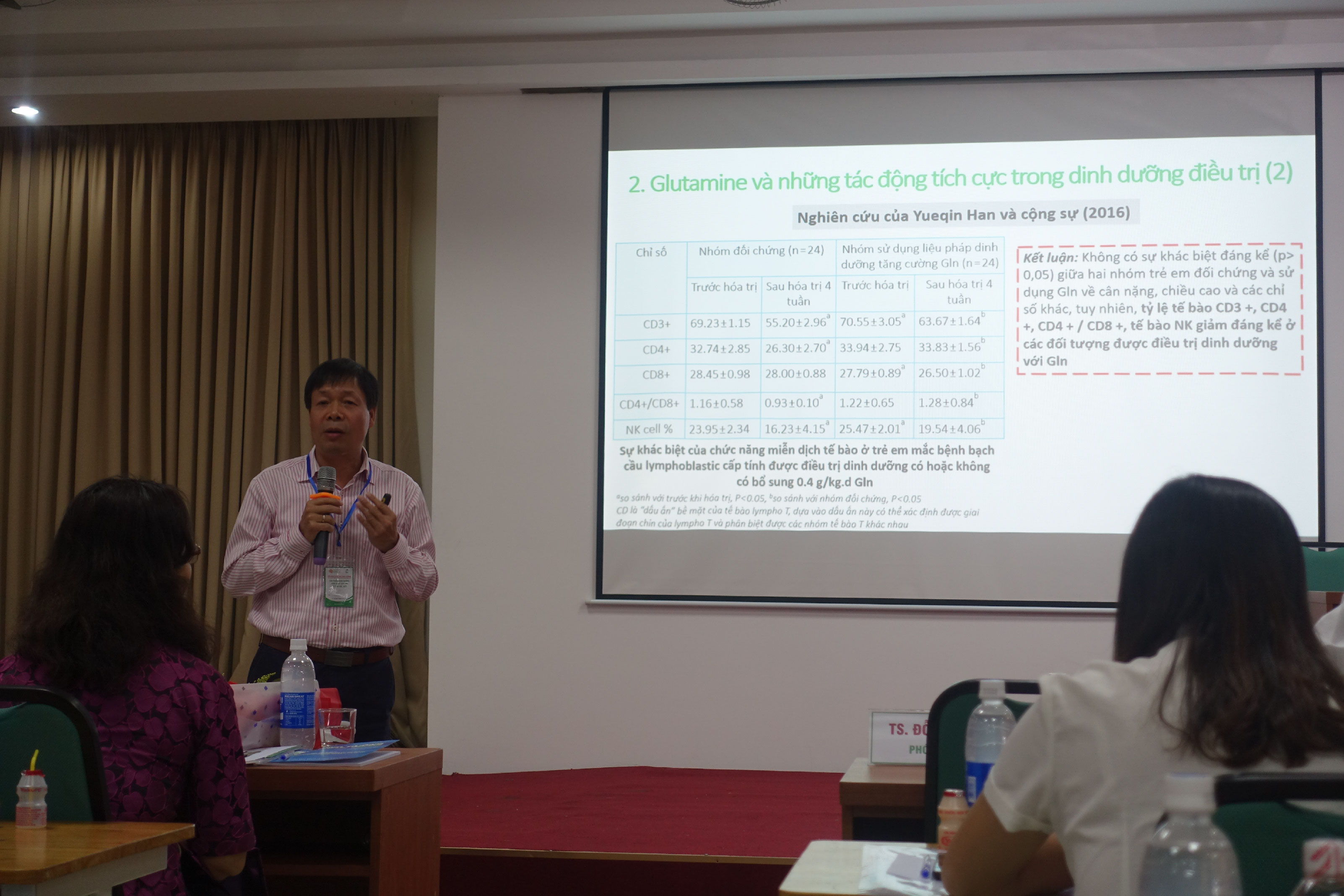
On May 22nd, in Da Nang, Vietnam Nutrition Association organized "Scientific Congress and Launching Ceremony of Nutrition Month of 2019" with the topic “Nutrition solutions for some metabolic diseases”. There were more than 100 representatives as doctors and lecturers from medical universities in the North and Central; health officials and nutritionists from health departments, health centers, reproductive health centers in Da Nang, Quang Nam, Thua Thien Hue and Quang Tri province; doctors and nutritionists from hospitals in Da Nang.
In the congress, amino acids’ role in supporting clinical nutrition was one of the topics receiving great attention and ebullient discussion of participants. Amino acids have not only essential physiological roles to human body, but also important roles in supporting clinical nutrition and can be applied into nutrition care process for patients, such as the effect of BCAA (branched-chain amino acids) in treating kidney disease at different stages. Among amino acids, glutamate can be considered a typical case for application in clinical nutrition support.
MSG – Application in supporting clinical nutrition
In the presentation named “Amino acids’ role in supporting clinical nutrition", Assoc. Prof. MD. Nguyen Do Huy – Director of Food & Nutrition Training Center, National Institute of Nutrition introduced the results of studies about using amino acids and especially glutamate via umami seasonings - MSG with glutamate as the main component as an effective solution in clinical nutrition support.
Besides its main function of bringing umami (the meaty, savory taste) for food, making food’s taste harmonious, thereby contributing to improve people’s quality of life, Assoc. Prof. MD. Nguyen Do Huy shared studies that proved MSG has many important physiological and nutritional functions to human body such as the effect in increasing saliva and gastric juice, speeding up the metabolism of protein-rich foods, improving digestive function and reducing post-operative diarrhea. These are solid scientific foundations for the application of MSG in clinical nutrition.
One of the interested typical applications is MSG’s ability to improve quality of life for elderly patients. A study by Tomoe M et al in Japan in 2009 showed that when adding MSG at the level of 0.5% to hospital meals within 3 months, the behavioral scores of elderly patients was improved obviously when comparing between the periods before and after 3 months of dietary intake with MSG. This improvement is observed, recorded daily and expressed specifically through the evaluation of some indicators such as activity, swallowing, cheering expression, etc. during eating.
In addition, MSG is also used as an effective method to reduce salt consumption, contributing to effectiveness of treatment of hypertension, kidney diseases, etc. A challenge of reducing salt in the diet is the impact on food’s taste, so it is extremely important to make a salt-reduced diet while not significantly sacrificing the taste of food. A study by Yamaguchi in 1984 showed that using MSG in appropriate combination with salt could reduce up to 50% of salt and 31.5% of sodium intake while maintaining the desired flavor and taste acceptability of food. Other studies implemented in the US, Finland and Malaysia gave similar results.
The method of reducing salt consumption by combining salt and MSG was mentioned as an effective and practical solution by numerous governments and regulatory & scientific agencies around the world. In the US, since 2010, the Salt Reduction Strategy Committee of the American Academy of Sciences has recommended the use of MSG in salt-reduced diets. In Vietnam, Ministry of Health's "Guidelines for Clinical nutrition" published in 2015 also recommended “The use of MSG at reasonable level (on average 0.4 - 0.5%) to enhance the flavor of low-salt food and support patients in maintaining well their clinical diets”.
MSG is a seasoning with a long-standing history, invented in 1908 by a Japanese professor, Dr. Kikunae Ikeda, leading to the birth of the world's first umami seasoning AJI-NO-MOTO®, the only Japanese MSG produced by Ajinomoto Group since 1909, with the aspiration of improving the nutrition of Japanese people at that time through delicious food.
Besides, MSG is one of the most researched food additives. Conclusions of governments and regulatory & scientific agencies around the world such as JECFA (The Joint FAO/WHO Expert Committee on Food Additives), the US Food and Drug Administration (US FDA), etc. proved that MSG is safe to be used for human as a food additive with acceptable daily intake “not specified” (daily intake depends on each kind of food and each individual’s taste). In Vietnam, the Ministry of Health places MSG in the "List of additives permitted for use in food".
Thus, amino acids in general and glutamate - MSG in particular have abudant applications in supporting clinical nutrition, not only enhancing the function of digestive system, but also improving the quality of life of elderly patients, reducing salt consumption in the diet to help maintain savory taste for food and reduce total sodium intake.
This presentation helps doctors, health officials and dieticians/nutritionists capture the knowledge and apply MSG to reduce dietary salt for patients. Simultaneously, through doctors and experts, this information will be shared widely to the community and general public, towards diets that help prevent chronic diseases for healthy people.